

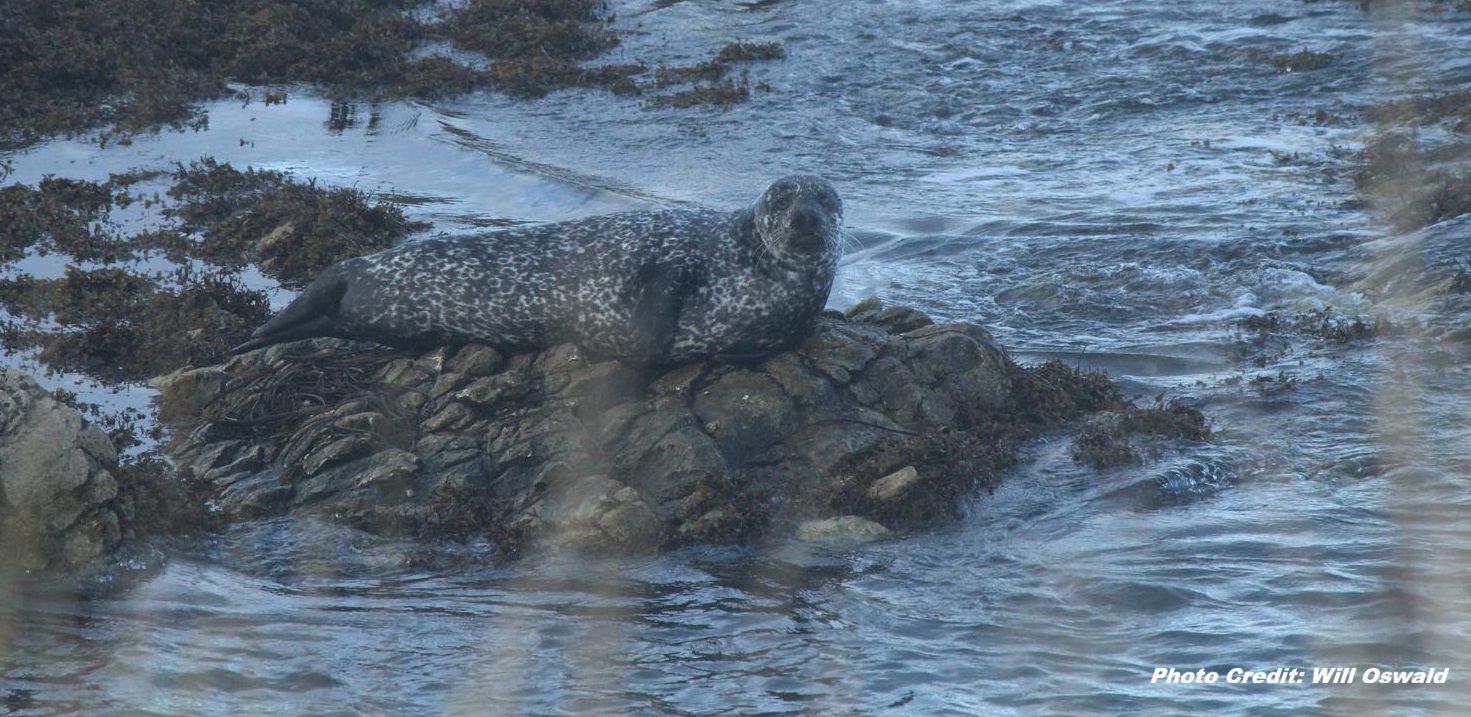
I saw my first seal of Rathlin while swimming in Mill Bay. It was a sunny afternoon, and the sea was still and calm. As we waded out past the rockpools jutting beyond the kelp house, the fulmars swooped overhead. The waves lapping the shore started breaking at our toes, then ankles, knees, hips, chest, and neck, setting my nerves on fire. I remember the brush of kelp as it wound round my ankles as I swam, its tickle frightening at first, fear and giddiness whirlpooling in my chest.
Then: a lone, slick, grey head emerging from the water, not ten metres away. For a moment neither of us moved. Bobbing with the glossy waves, it stood guard at the bay’s opening like a goalkeeper between posts. This being my first time this near to a seal in the open ocean, I was terrified. It didn’t move, but it peered at us with an unnerving confidence. This was enough cause for me to quickly start paddling back to shore.
Since that first encounter in October, I have been sea swimming many times. The burn of the cold water still feels like both a privilege and a torture. And now I live nearer the harbour, I’ve migrated my swims north to Church Bay. Here, the seals are different.
Church Bay seems like the perfect playground for our curious friends, the outreaching arms of the rock walls wrapping the quiet cove in a protective hug. The secret beach seems to be a favourite spot of theirs; my heart jumps a little every time I walk past, hoping to see their banana pose on the shoreline.
I was surprised by how comfortable the seals were with the level of human activity in Church Bay. My housemates, Will and Aileen—both conservationists—have spent far longer watching seals than I have. Aileen even wrote her master’s thesis on the impact of anthropogenic activity on grey seals at Angel Bay, North Wales. They say that seals are potentially more likely to show a higher level of habituation in Church Bay, because they’ve encountered increased anthropogenic behaviour.
Over the last couple of months, the seals and I have developed a friendship of sorts. They come to say hello when I paddle around the dock, gently slipping under the shining surface of the rippling water and quietly reappearing a few moments later.
They appear when I am walking along the beach in Church Bay, splashing in the shallows and gazing at the darkening sky. They come when I sing at the water’s edge, circling through the water, tossing their heads, noses pointed to the sky as they bottle, bobbing, beckoning me in. They greet me in the morning with flips at the pier.
There is one grey seal in particular who has become my friend. Pontoon, as we have named her, is playful and curious, and the liveliness of her spirit fills me with joy. Aileen reckons that Pontoon is a female, due to her nose shape. She tells me that a male will have more of a Roman nose shape compared to a female’s rounded one.
I have a very limited understanding of seals’ behaviour and biology. However, I can recognise the glint in Pontoon’s eye from metres away, just before she slips below the surface. In those moments, the water goes strangely quiet, as if the whole bay is holding its breath. I know the flip of her tail which precedes a jump; the weight of her gaze when we lock eyes as she bottles, the sea gently lapping the toes of my boots as I stand on the shore.
With each swim, her confidence grows. She ventures closer and closer as I paddle to and from the dock. There is, though, an understanding that as much as she gets close, it is entirely on her own terms. As much as I might wish to swim and splash around with her, it is right that she remains aloof.
Our friendship was born out of curiosity and play, but it persists through mutual respect and a shared love of the water. The freedom I experience in her company feels the same as a gust of crisp air that whips through my hair on a mountainside, yanking strands from my braid.
I wonder if she enjoys my singing as she swims back and forth while I stand on the beach, or if she is only lonely. There is also a high probability that she just wants some peace and quiet away from my warbling, but I choose to believe that she simply fancies my company.
I wonder if she’ll miss my company once I leave Rathlin. I’ve been swimming with her at least once a week since January, and I wonder who she might play with instead.
As the weeks wind down to the end of the project, I also wonder how I will manage being away from Rathlin. Six months here has brought its hardships, but it has also given me friendships—human and otherwise—greater than I could have expected.
By Manika Patel, LIFE Raft Fieldworker
Disclaimer
LIFE Raft operates under license as part of the eradication project.
Seals are a protected species in Northern Ireland under the Wildlife (Northern Ireland) Order 1985. It is an offence to intentionally or recklessly disturb seals, particularly during sensitive periods such as breeding and pupping seasons.
Human disturbance can have serious consequences for seal welfare. Repeated disturbances may cause a mother seal to abandon her pup and return to the water. This disruption can irreversibly damage the bond between mother and pup and, in some cases, threaten the pup’s survival.
For this reason, strict protections are in place to minimise disturbance to seals and their haul-out sites. Observations described in this piece were conducted responsibly and at a distance that did not interfere with natural behaviour.